— BUYING GUIDES
Compostable Food Packaging Wholesale: Building a Full-Range Sourcing Program
10 November 2026 • Buying Guides • 5 min read
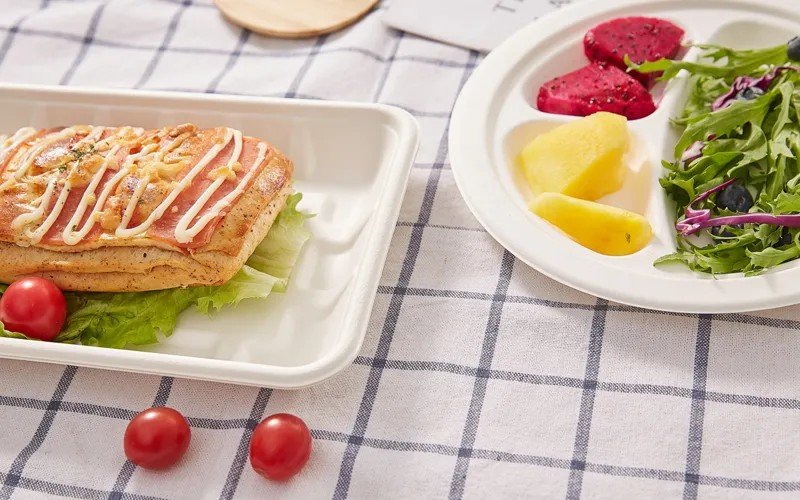
Most importers do not switch to compostable packaging in one decision. They switch one product at a time — a plate here, a burger box there — because one customer asked, or one regulation deadline landed. Two years later the range is a patchwork: three suppliers, four material stories, documents in different formats, and no single shipment that makes economic sense.
Compostable food packaging wholesale works better as a program: one audit of what you currently buy in plastic, one mapping onto moulded fibre equivalents, and one supply relationship that can carry the whole range.
This guide is written for importers and distributors who carry food packaging across several categories, not just one hero product. It covers how to audit your existing plastic SKUs for a compostable food packaging wholesale switch, how to map them onto bagasse moulded fibre category by category, how to sequence the switch so you never bet the business on an untested item, and how mixed container loads make per-SKU minimums workable at program level. It closes with the certification document pack you should assemble for each destination market before the first full shipment leaves.
We are Hebei Daoxiang Eco Tableware Technology Co., Ltd. We run our own moulding factory in Hebei, China, producing tableware from sugarcane bagasse plant fibre. The range runs to 126 products in six collections, spanning plates, bowls, trays, cups, clamshells, containers and cutlery — the full set of categories a program has to cover. What follows is the sequence we recommend, whether the program ends up with us or with another factory.
Step 1: Audit the plastic range you already sell
You cannot map what you have not listed. Start with your current plastic and foam catalogue — every SKU you actually move, not every SKU you have ever stocked. For each line, record what a replacement decision needs:
| Audit field | What to record | Why it matters |
|---|---|---|
| Current SKU and format | Material, shape, size or capacity | The mapping unit — one line, one replacement decision |
| Monthly or seasonal volume | Real sales, not warehouse stock | Decides which SKUs justify a trial order first |
| Food application | What is actually served in it | Wet, oily and dry foods map to different fibre formats |
| Customer type | Retail, foodservice, institutional | Determines packing format and document expectations |
| Destination market | Country or region sold into | Drives which certifications and test reports you need |
| Known pain points | Leaks, breakage, customer complaints | The failures your replacement must not repeat |
Two findings usually come out of this exercise. First, the active range is smaller than the catalogue suggests — a minority of SKUs carry the volume, and those are your trial candidates. Second, some plastic items have no honest fibre equivalent: a transparent salad dome bought for visibility does not become a bagasse product. Mark those lines “no direct equivalent” now. A program that admits its gaps up front survives contact with customers; one that promises a one-for-one swap for everything does not.
Step 2: Map each plastic SKU to a moulded-fibre equivalent
With the audit in hand, work category by category. Bagasse moulded fibre covers most of a standard foodservice range, but each category maps with its own caveats:
| Plastic range today | Moulded-fibre equivalent | Mapping notes |
|---|---|---|
| Plates (round, square, compartment) | Bagasse plates in the same size bands | The cleanest swap in the range; check compartment layouts against your menu portions |
| Soup and salad bowls | Bagasse bowls, with lids where the plastic line had them | Match capacity and lid type together, not the bowl alone |
| Hinged takeaway boxes | Bagasse clamshells | Best for dry and semi-dry food; very wet dishes belong in lidded formats instead |
| Rectangular meal trays | Bagasse trays, flat or compartmented | Institutional and meal-prep lines usually map well; confirm portion geometry |
| Portion and sauce cups | Small bagasse cups in the common 1–4 oz bands | Lid fit is the detail that decides success; test the exact cup-and-lid pair |
| Lidded food containers | Bagasse containers with separate lids | The workhorse for saucy and delivered food; sample with real dishes |
| Plastic cutlery and wrapped sets | Paper-based cutlery, including individually wrapped sets | Set composition (fork/knife/spoon/napkin) must match what your customers bundle today |
Descriptions above follow the size and format bands buyers typically source in the market; the exact items in any program are fixed when you compare your audit list against a specific factory catalogue. Our own range — 126 products in six collections — is published on our product page, and the mapping conversation is usually a working session over your audit table, not a catalogue browse.
One rule governs the whole step: map by application, not by appearance. A fibre item that looks like the plastic one may still be wrong for the dish it has to hold. Ask it to handle food that is wetter, hotter or longer-stored than it suits, and it will fail in the field — and take the program’s credibility with it. Where the mapping changes the format — hinged box to lidded tray, say — flag it for your sales team early, because customers will notice and should hear the reason from you first.
Step 3: Sequence the switch — samples, trial SKUs, full range
A program is not a single order; it is a sequence in which each stage buys information for the next.
Stage 1 — Samples across the mapped range. Order samples of every mapped equivalent, not just the high-volume lines. We dispatch samples free within 3 days, and the test that matters is your own: your customers’ food, your delivery distances, your shelf and stacking conditions. Kill weak mappings here, while killing them is cheap.
Stage 2 — Trial SKUs at minimum quantity. Convert the proven, high-volume lines first. Our minimum is 5,000 pieces per SKU from stock moulds, which at trial stage is a feature: it qualifies a line in the real market without a warehouse commitment. Keep the plastic original running until the fibre line has survived a full sales cycle with your most demanding customer.
Stage 3 — Full-range conversion. Once trial lines reorder, extend the program to the long tail — the seasonal, regional and customer-specific SKUs from your audit. This is also the stage where a custom shape earns consideration: a dedicated mould starts at 20,000 pieces, and it only makes sense for a line whose volume you have already proven on a stock mould.
Production runs 15–20 days per order cycle, so the sequence has a calendar logic too: samples in week one, a trial order produced inside the first month, and reorders planned against the next cycle rather than a stockout.
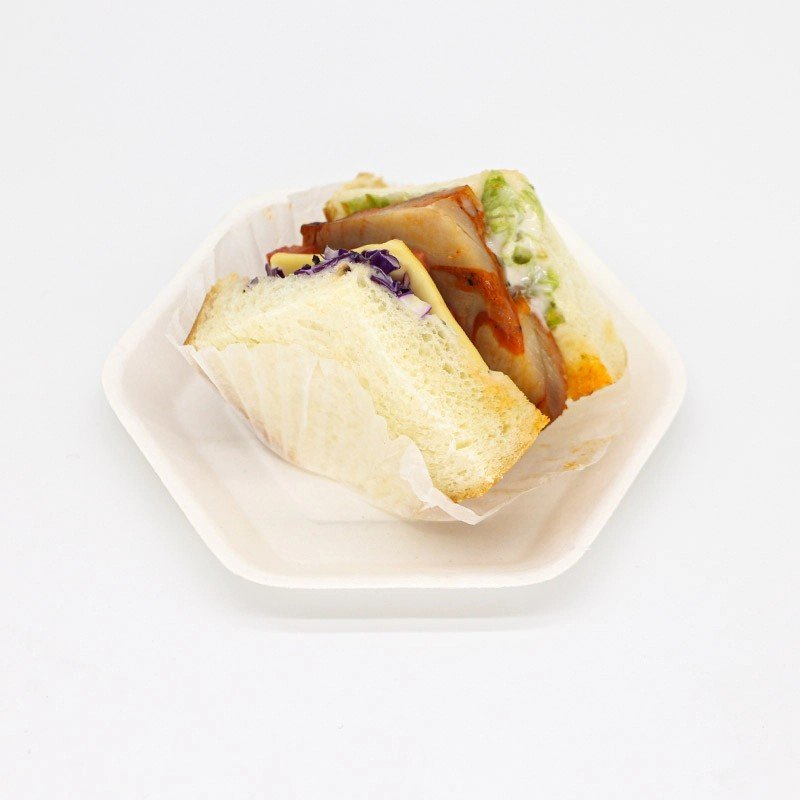
Compostable food packaging wholesale: the container maths behind the program
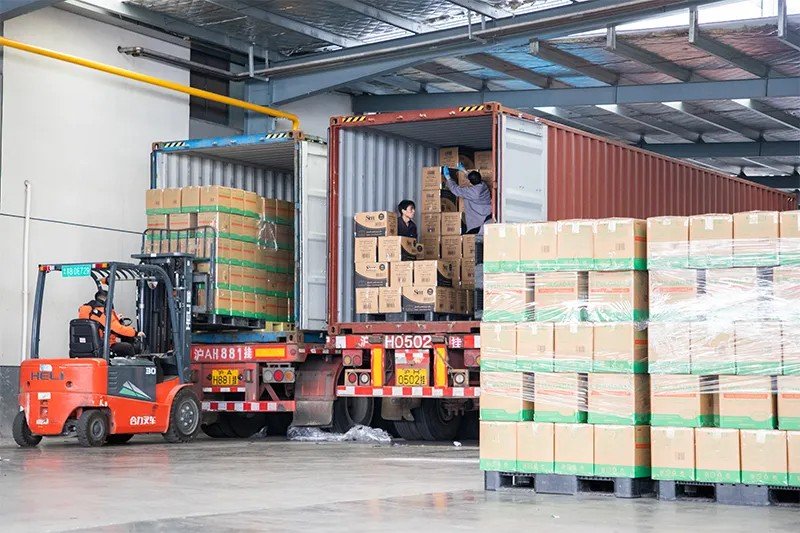
The reason a program beats piecemeal buying is freight. A single SKU ordered alone carries its shipment cost alone; twenty SKUs from one factory travel together. Each SKU still meets its own minimum — 5,000 pieces from a stock mould — but the lines consolidate into one load, and the freight is shared across the program instead of charged against one box size. That is how a distributor carries breadth — plates and bowls for retail, trays and clamshells for foodservice, cups and cutlery to complete the ticket — without twenty separate supply relationships.
Piecemeal buying has a second, quieter cost: specification drift. Different suppliers’ “compostable” products arrive with different materials, documents and consistency from order to order. A single-factory compostable food packaging wholesale program holds one material story — sugarcane bagasse fibre — and one document set across the range, which is what your compliance file and your customers’ questions actually need.
If your program is specifically a takeaway-container conversion — clamshells versus lidded trays, menu by menu — our dedicated guide to compostable takeaway containers wholesale goes deeper on that one category than this program overview can.
The document pack behind a compostable food packaging wholesale program
A full-range compostable food packaging wholesale program multiplies SKUs, which multiplies the paperwork question. Handle it as a pack, assembled per destination market before the first full shipment — not as a scramble after an inspector asks.
- Collect certification documents for the exact SKUs in the program. Our range is certified to FDA, LFGB, EN 13432 and ISO 9001, and the documents are supplied per product. Check that each certificate’s holder, product description and scope match the items on your order.
- Match documents to markets. Buyers typically file EN 13432 compostability documentation for Europe, LFGB for Germany, and FDA documentation for the United States. The same SKU may need different papers in different markets — file by market, not by product alone.
- Request test reports per SKU for any specific claim your market makes. If a customer or a regulation asks about a particular substance or property, the answer is a test report for that item, not a general statement from a supplier. Ask for the report, read its scope, and file it against the SKU.
- Agree the terminology your program will use. “Compostable” is a certified claim with a standard behind it; “biodegradable” is a broader word with a looser meaning, and using the two interchangeably in your own marketing creates exactly the compliance risk the program is meant to remove. Our companion guide to biodegradable food packaging wholesale works through that distinction from the buyer’s side — read it before you print a catalogue page.
Keep the pack alive: when a SKU is added, substituted or re-sourced, its documents are re-checked at that moment, not at the next audit.
Frequently asked questions
Do I have to convert my whole range at once?
No — and you should not. The program structure exists so you can sequence it: audit everything, sample everything, but convert in stages, starting with high-volume lines that passed your tests. The audit is full-range; the orders do not have to be.
Can different categories really ship together in one load?
Yes. Because every line comes from one factory, the cartons consolidate into a single shipment under one set of shipping documents. Each SKU still meets its own minimum — 5,000 pieces from stock moulds in our case — but no single line has to fill a container by itself.
What if some of my plastic SKUs have no fibre equivalent?
That is a normal audit result, not a program failure. Transparent, visibility-led packaging is the usual case. Mark those lines honestly, decide whether a lidded fibre format can serve the application differently, and keep the program moving — a partial conversion with no false claims beats a promised full conversion that breaks in the field.
Which certifications should the document pack contain?
It depends on the destination market. Our range carries FDA, LFGB, EN 13432 and ISO 9001 certification, supplied per product. File the compostability documentation your market requires, the food-contact documentation for that market, and per-SKU test reports for any specific claim a customer asks you to support.
When does a custom shape make sense in a program?
After a stock-mould line has proven its volume. Custom shapes start at 20,000 pieces per SKU, so treat the custom decision as a scaling step in stage three of the program — usually for your best-moving line — not as a starting point.
How long does a compostable food packaging wholesale program take from first samples to full range?
The fixed points are short: samples leave within 3 days, and production runs 15–20 days per order. The variable is your own testing and your customers’ sales cycles. Most of the elapsed time in a well-run program is stage two — letting trial SKUs prove themselves in the market before the long tail converts.
Browse the full range on our product page to see the six collections your program would draw from. Or send the audit list through our contact page and we will reply with the mapping, the per-SKU minimums and the document pack for your market — no catalogue pitch, just the working table.