Bagasse Clamshell Burger Box Wholesale: Sizes, Strength and Custom Options
8 November 2026 • Buying guides • 4 min read
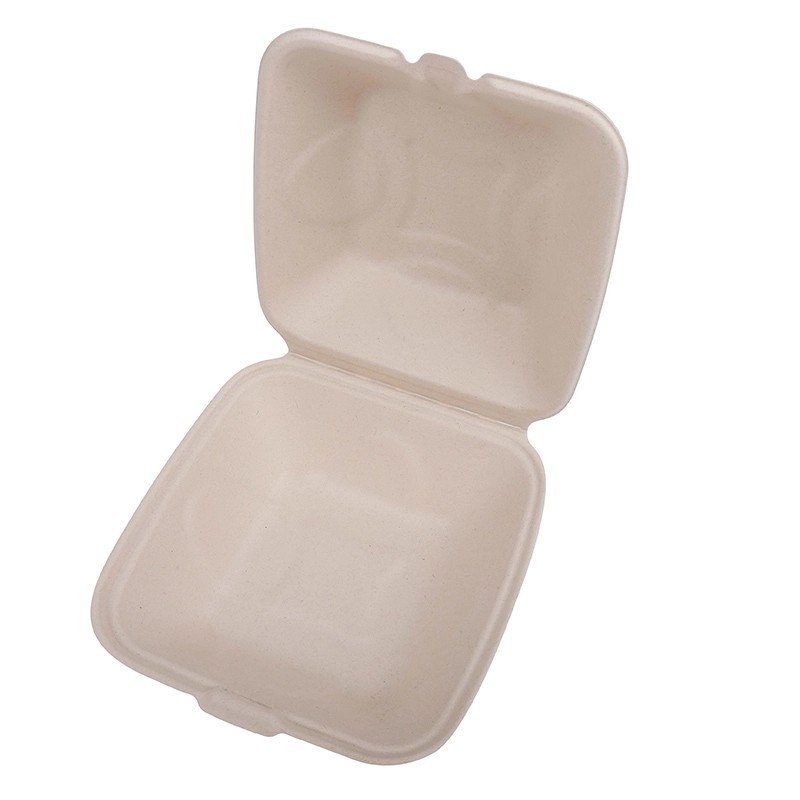
If you buy takeaway packaging in volume, the burger clamshell is usually the first product that tells you whether a supplier is worth a second conversation. Bagasse clamshell burger box wholesale orders are a useful test case. The product looks simple, but it fails in very specific ways: a hinge that cracks on the second opening, a lid that softens over a hot patty, a stack that slides around in a delivery bag. This guide works through those failure points in the order a buyer meets them: size first, then strength, then heat and grease, then logistics. The aim is simple — judge samples and quotations on the details that decide repeat orders.
At Daoxiang we mould the full range in our own factory in Hebei, China, as part of a 126-piece catalogue across six collections of sugarcane bagasse tableware. The clamshell burger box is one stock item inside that wider range, which matters when you want to consolidate plates, bowls and containers into combined shipments later.
Bagasse Clamshell Burger Box Wholesale Sizes: What Buyers Usually Stock
Buyers rarely stock one size. A typical wholesale assortment covers a compact single-burger box, a standard single with room for toppings, and one or two larger formats for double burgers and burger-plus-fries meals. The dimensions below are the size bands buyers commonly ask for across the market; treat them as a starting grid for your own specification, not as a fixed catalogue list.
| Format buyers ask for | Typical footprint band | Suits | Specification points to confirm |
|---|---|---|---|
| Compact single | Around 5–6 inch square class | Sliders, small patties, kids’ burgers | Internal height — a thick bun needs more headroom than the footprint suggests |
| Standard single | Around 6×6 inch class | The default burger-shop size | Corner clearance so the bun is not compressed when the lid closes |
| Large single / double | Around 8×8 inch class | Double patties, stacked burgers, loaded toppings | Lid stiffness over the wider span; hinge travel at full open |
| Meal box | Around 9×9 inch class, sometimes compartmented | Burger with fries or sides in one box | Whether fries sit in a divider or loose against the burger — condensation behaviour differs |
Two sizing mistakes come up again and again. The first is specifying by footprint only: two boxes with the same footprint can have different internal depths and corner radii, and a burger that clears one will squash in the other. Ask for internal dimensions, or better, test with your actual product. The second is ordering the large format for everything to “be safe.” Oversized boxes let the burger slide, look sparse in presentation photos, and waste shelf and case space across thousands of units.
For the stock-mould range, our minimum order for bagasse clamshell burger box wholesale is 5,000 pieces per SKU. That makes it practical to split an order across two or three size SKUs, rather than forcing one size to cover the whole menu. You can see where the burger boxes sit inside the wider range on our full product catalogue.
Hinge Strength and Open–Close Life
The hinge is where a moulded fibre clamshell earns or loses its reputation. Kitchen staff open and close these boxes constantly — at the pass, during packing, and again when the customer opens the delivery. A weak hinge shows three symptoms: whitening along the fold line, a lid that will not stay open flat on the bench, and corner tabs that tear instead of clicking shut.
When you evaluate samples for a bagasse clamshell burger box wholesale order, run a simple open–close test before anything else. Open and close the box twenty times at working speed. A sound hinge flexes without cracking or shedding fibres, and the lid still aligns with the base at the end of the test. Then load the box with a real burger, close it, and carry it by one corner for a few metres — if a lid is going to pop in service, this simple test usually exposes it first.
Wall thickness distribution matters more than average weight. Some boxes feel heavy yet have a thin, brittle hinge line because material did not distribute evenly in the mould. Flex the hinge rather than weighing the box, and compare two or three samples from the same batch, not a single hand-picked piece. Consistency across the batch is what your customers’ kitchens will experience.
Grease Resistance, Steam and Condensation
A burger is a hostile load for any fibre box: hot, fatty, and steaming. The grease side is the easier half. Do not take any supplier’s word for grease performance — the practical check is time-based. Put a sauced burger in the box, and inspect the base after thirty and sixty minutes for strike-through or a softened, saturated patch under the patty.
Steam is the harder problem, and it is the one buyers most often misdiagnose as a material defect. A freshly cooked patty releases moisture that condenses on the inside of the lid. That condensate can soften the lid surface and, worse, drip back onto the bun. No fibre box makes steam disappear; the variables you control are headroom, venting and dwell time. A box with a little air space above the burger condenses less on the food itself. Some buyers specify small vent features, while others manage it operationally — resting the burger briefly before closing, or closing the lid at the last moment before the bag is sealed.
Be precise in your specification about the use case. A box that performs perfectly for a ten-minute counter sale may disappoint on a forty-minute delivery route. The box has not changed — the steam simply had four times as long to work. State your real delivery window when you request samples, and test against that window rather than against a best case.
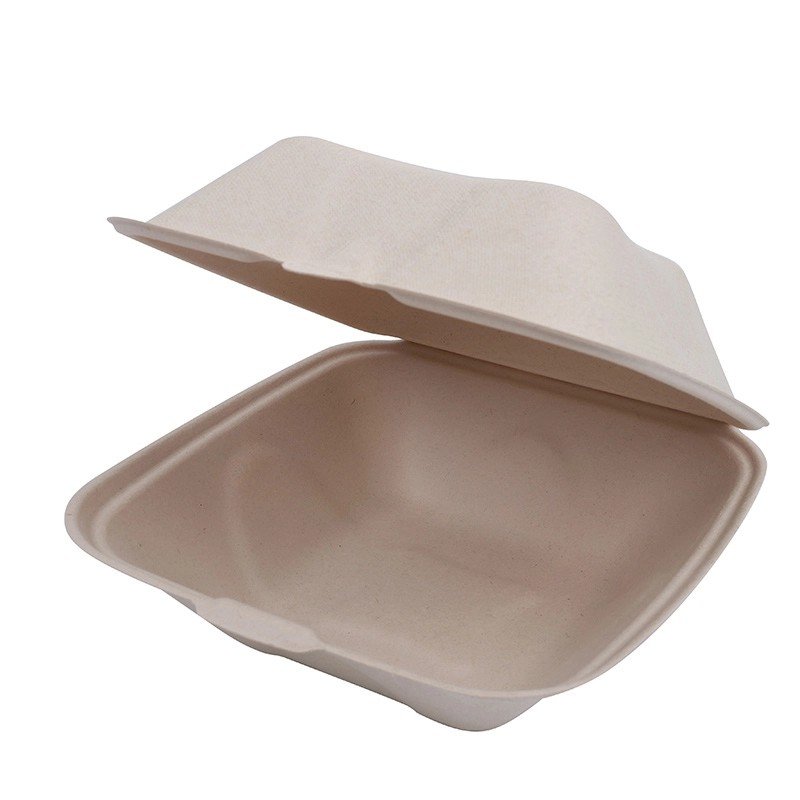
Bagasse Clamshell Burger Box Wholesale Packing: Stacking in Bags and Cases
Clamshells work in a stack twice: filled boxes stacked in the delivery bag, and empty boxes nested in storage and in the shipping case. On the filled side, look at how the lid profile bears load. A flatter lid with a defined rim stacks stably; a domed lid rounds the contact point and lets the pile lean. In the bag, ask whether the closure resists the sideways squeeze of other items — the tab design decides this more than the wall does.
On the empty side, nesting depth is a freight question as much as a storage one. Boxes that nest tightly ship more efficiently, and they take up less back-of-house shelf space. How cases are packed and loaded for sea freight is covered in our separate shipping and loading guide — confirm packing format early, because it affects both your landed cost and how the boxes arrive.
One operational detail worth specifying: how the boxes separate. Kitchen staff pull nested clamshells apart one-handed at speed. If the boxes vacuum-lock together, service slows and staff start tearing them apart — which brings you back to hinge damage before the box is even used. Denesting behaviour is easy to test with a sample stack and impossible to judge from a photograph.
Custom Printing, Embossing and Private Label
There are three distinct branding routes for a bagasse clamshell burger box wholesale order, and they sit at very different commitment levels. The lightest is a printed or labelled outer pack — your brand on the retail or wholesale packaging while the box itself stays plain. The middle route is embossing or debossing in the mould, typically a logo on the lid. It uses no inks on the food-contact surface, feels clean and premium, and survives handling. The deepest route is a fully custom shape, which means new tooling.
If the shape itself has to change, that is a custom-mould project rather than a printing decision — the process from drawing to production is set out in our custom moulds guide, and custom shapes at Daoxiang start from 20,000 pieces rather than the 5,000-piece stock minimum. For most buyers, the practical sequence is to prove the stock sizes first, then add embossing or printed packaging once volumes are steady.
Private label programmes — your artwork, your barcodes, retail-ready packs — follow the route described in our private label and OEM guide. One caution that applies to every route: approve branding on a physical sample, not a render. Embossing depth and print contrast on bagasse read differently in the hand than on screen, because the fibre surface is matte and slightly textured.
Clamshell or Paper Wrap? Choosing by Scenario
Some buyers ask whether they should switch from wrap to clamshell entirely. The honest answer is that the two formats do different jobs. A paper wrap is cheap, compact, and fine for a burger eaten immediately at the counter. It offers no structure, no stackability, and no protection once the bag is loaded with drinks and sides.
A clamshell protects the product shape, stacks predictably, presents better for delivery platforms, and keeps fries or toppings in place. It takes more storage volume and suits a menu where presentation on arrival is part of what the customer pays for. Many operators run both: wrap for counter service, clamshell for delivery orders. That split is usually decided by the delivery share of the business, rather than by unit cost alone.
If your sales are mostly delivery, weight the decision toward the clamshell and test it on your longest route. If your sales are mostly counter, the wrap may remain your workhorse and the clamshell a line for premium or set meals. Either way, the comparison should be made with your food, your routes and your staff — not from a supplier’s brochure, ours included.
Frequently Asked Questions
What is the minimum order for bagasse clamshell burger boxes wholesale?
For stock moulds, our minimum order for bagasse clamshell burger box wholesale is 5,000 pieces per SKU, which lets you split a first order across the two or three sizes your menu actually needs. Fully custom shapes start at 20,000 pieces. The full ordering picture — samples, lead times and terms — is explained in our MOQ, samples and lead times guide.
How long do samples and production take?
Bagasse clamshell burger box wholesale samples are free and are sent within three days, so you can run hinge, grease and stacking tests with your own food before committing. Regular production runs on a 15–20 day cycle once an order is confirmed.
Will the box go soft under a hot burger?
Heat alone is rarely the issue; steam is. Over a normal meal window the base is rarely the weak point, but a sealed box on a long delivery route traps condensate against the lid. Correct sizing with headroom, and closing the lid late in your packing sequence, make the practical difference — test with your real delivery time.
Which certifications support sales in Europe and the US?
Daoxiang tableware is certified to FDA and LFGB food-contact requirements and to EN 13432 for compostability, and the factory operates under ISO 9001. Ask for the current documents for the specific items you are buying, and confirm they match the market you sell into.
Can I put my own logo on the boxes?
Yes — for bagasse clamshell burger box wholesale orders, the usual routes are embossed or debossed lid branding in the mould, printed outer packaging, or full private label packs. Approve any branding on a physical pre-production sample, because contrast on bagasse fibre looks different from a screen render.
Start with samples, tested your way. Tell us the sizes you are considering and your typical delivery window. We will send free samples within three days, so you can run the hinge, grease and stacking checks in this guide with your own burgers. Message us on WhatsApp at +86 18733012158 or send your bagasse clamshell burger box wholesale specification through our contact page — Hebei Daoxiang Eco Tableware Technology Co., Ltd., factory-direct from Hebei, China.