— BUYING GUIDES
Bagasse Trays Wholesale: A Factory-Direct Buying Guide
10 November 2026 • Buying Guides • 5 min read
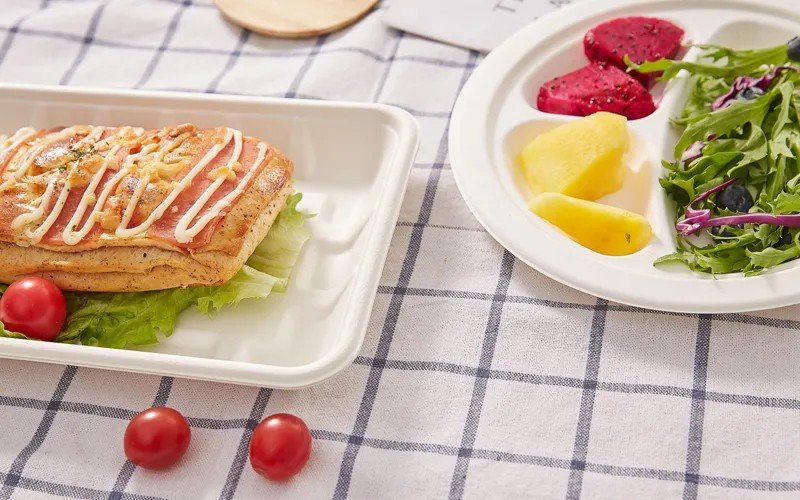
Trays look like the simplest item in a bagasse range — a flat sheet of moulded fibre with raised edges. Then the first order arrives and the problems show up: trays that bow under a loaded meal, lids that almost fit, compartment sections sized for a menu nobody serves. None of these are material failures; they are buying decisions made too quickly. This guide covers what importers and distributors check before placing bagasse trays wholesale orders: formats, compartment counts, lid matching, stiffness, stacking, MOQ and the sample tests that catch problems early.
We write this from the factory side. Hebei Daoxiang Eco Tableware Technology Co., Ltd. runs its own moulding plant in Hebei, China, producing compostable, biodegradable tableware from sugarcane bagasse fibre — 126 items across six collections.
Trays sit alongside our plates, bowls and containers in that range. If you are comparing bagasse trays wholesale offers from several factories, the checks below will help you judge the product in front of you, not the one in the catalogue photo.
Choosing tray formats for bagasse trays wholesale orders
Format decides who can use the tray and how it is packed, so it comes before size. In wholesale tray purchasing, four formats cover most of the market:
- Open food trays are the workhorse for fast food, bakeries, food trucks and market stalls — fries, fried chicken, pastries, grilled items. Chosen for speed of service.
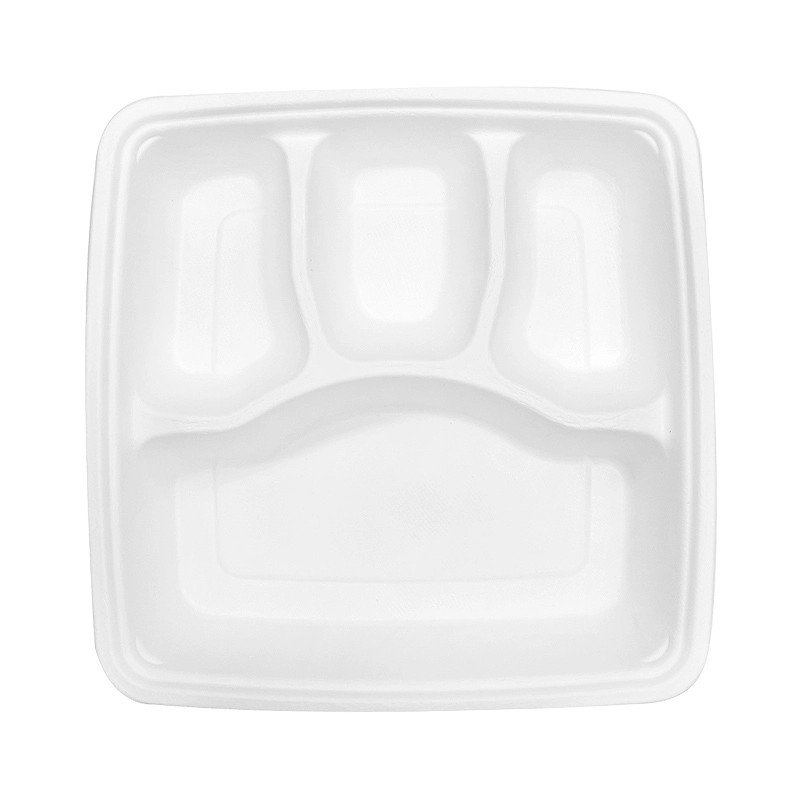
- Compartment and meal trays divide a meal into sections, typically 3 to 6, for canteens, schools, hospitals, airlines and meal-delivery programmes. The divider walls are structural as well as functional: they stiffen the tray.
- Lidded trays pair a moulded base with a separate lid for retail-ready meals, sushi, salads and prepared food that travels. Treat base and lid as one SKU decision, not two.
- Supermarket fresh-food trays replace foam trays under meat, fish, fruit and vegetables in retail display. They are shallow, sized to shelf and film-wrapping equipment, and judged on presentation as much as strength.
A practical starting point: pick the format by the serving situation, then check the formats we run in our full product range against the customers you actually supply.
| Format | Typical use | Buying note |
|---|---|---|
| Open food tray | Fast food, bakeries, food trucks | Fastest service; check edge stiffness when loaded |
| Compartment / meal tray, 3–6 sections | Canteens, schools, hospitals, meal delivery | Dividers add rigidity; match sections to the real menu |
| Lidded tray | Sushi, salads, retail-ready meals | Base and lid must be tested as a pair |
| Supermarket fresh-food tray | Meat, fish, produce display | Shallow format; check film-wrap and shelf fit |
One caution applies to every format: a tray is a large, flat piece of moulded fibre, so it shows flexing more readily than a small, deep item like a bowl. That is why the stiffness checks further down matter more for trays than for almost any other item you will order.
Sizes and compartment counts buyers commonly source
Tray sizes are quoted in inches or by footprint dimensions, and buyers work within familiar bands rather than a single standard. Small open trays in roughly the 5×7 to 6×8 inch range handle fries, snacks and bakery items. Mid-size trays around 8×6 to 9×7 inches cover burgers with sides, fried chicken portions and café meals. Large trays in the 10×8 inch class and above serve full meals, sharing portions and catering. Compartment meal trays are most often sourced in footprints comparable to a dinner plate — the 9×9 inch class is the common starting point — so each section holds a real portion.
Treat these as market conventions for building a shortlist, not as a specification sheet. Two sizing mistakes come up repeatedly in bagasse trays wholesale sourcing:
- Compartments counted before portions. A 5-compartment tray sounds versatile, but if your customer’s menu is a main, one side and a sauce, three sections serve it better and leave each portion looking generous. Count what has to stay separate, then choose the tray.
- Footprint checked, depth ignored. A shallow tray with the right footprint can still spill in delivery if its walls are lower than the foam tray it replaces. Check wall height against the food, especially items served with sauce.
Depth matters for stacking too: small differences in wall angle decide how tall a nested stack sits, which decides carton size and warehouse space. Ask for a sample stack of the exact tray you plan to order and measure it, rather than estimating from a single piece.
Stiffness, load and stacking checks for trays
A tray is carried by its edges, often in one hand, often loaded unevenly. That makes it the easiest bagasse item to buy badly. Run these checks on samples before approving any bagasse trays wholesale order.
The one-hand carry test
Load the tray the way your customer will: the heaviest realistic serving, placed the way staff actually place it. Pick it up by one short edge and walk a few steps. A sound tray flexes slightly and stays level enough to carry. A weak one bows in the middle, tips the load, or cracks at the rim.
The sauce and grease test
Serve the wettest, oiliest item on the menu, leave it for a full service period, then check the underside for soak-through and whether the base has softened where liquid pooled. On compartment trays, check the divider feet: liquid creeping under a divider into the next section is a common failure that only shows up with real food, never in a showroom water test.
The stacking test
Stack loaded trays the way they will be stacked in service or in a delivery bag — three or four high — and leave them for fifteen minutes. The bottom tray should hold its shape without the base sagging onto the food below. Then check empty stacks: trays from the same mould should nest evenly, release without jamming, and separate without tearing edges.
Stiffness is the physical test; compliance is the paperwork test. Our tableware is certified to FDA, LFGB and EN 13432 requirements, with production under ISO 9001. Where a buyer needs supporting test documentation for a specific tray or market, request the reports per SKU before ordering, so the paperwork is checked against the exact items being imported — the same discipline we recommend for bagasse food containers.
Lid options, packing and container loading
For lidded trays, the lid is half the product. Buyers generally choose between three routes, each with a trade-off:
- Moulded bagasse lids match the base material and keep the pack fully fibre-based. They are opaque, so they suit meals that do not need to be seen.
- Clear lids show the food, which is why retail and sushi programmes prefer them. The lid material differs from the base, so check how the finished pack is described to your customers.
- Film sealing suits supermarket fresh-food trays and prepared meals packed on sealing equipment. It depends on the tray rim being flat and consistent, so rim finish becomes a production specification, not a detail.
Whichever route you take, test base and lid as a pair: fit after the base is loaded, fit after an hour in a chiller, and fit after the stack has sat under the weight it will carry in a carton. A lid that fits an empty tray can still pop off a loaded one in a delivery bag.
Trays ship as nested stacks, and how the stacks are sleeved and cartoned decides the condition of the rims on arrival. Agree the packing format before production, and on arrival inspect trays from several cartons, not only the top one.
Finally, trays are bulky relative to their weight, so most importers do not fill a container with trays alone. They combine tray SKUs with denser items from other collections — plates, bowls, containers, cups — so bulky trays do not consume the whole shipment. Plan the mix at the order stage and let the factory load against that plan.
How the 5,000-piece MOQ works in bagasse trays wholesale orders
Our minimum order for items from existing moulds is 5,000 pieces per SKU. In bagasse trays wholesale terms, a SKU is one format in one size — and for lidded trays, the base-and-lid combination is what counts, so confirm how a set is defined when you enquire. A 4-compartment meal tray and an open fast-food tray are separate SKUs, each with its own minimum. Custom shapes are a different route: they need a new mould and start at 20,000 pieces.
The per-SKU structure rewards focus. A distributor launching trays typically starts with two or three SKUs — say a mid-size open tray, a compartment meal tray and one lidded format — each at or above the minimum, rather than thin quantities across the whole range. Production runs on a 15–20 day cycle once the order is confirmed.
Testing samples before you commit
Free samples are dispatched within three days, and for trays they are not a formality: their weaknesses are easy to find if you test properly, and expensive to find after production. Run a short written protocol and keep the results against the SKU reference.
- Load it like service. Use your customer’s real menu: the heaviest main, the wettest side, the oiliest item. Test the worst case, not the average.
- Carry it one-handed. Pick the loaded tray up by one edge and walk with it. Note any bowing, tipping or rim cracking.
- Leave it loaded. Let a saucy serving sit for a full service period, then check the underside and the compartment dividers.
- Fit the lid loaded, not empty. If the tray takes a lid or film, run the pair tests set out in the lid section above before you approve the SKU.
- Check the stack. Pull trays from the middle of the sample stack. Look for warping, uneven rims and trays that jam or tear on separation.
- Test your own packing. If you repackage trays into retail or foodservice packs, run samples through your packing process before ordering volume.
Keep one approved sample set as your reference standard. When the production order lands, compare incoming trays against it — same carry behaviour, same lid fit, same nesting. Buyers who order trays alongside other categories run the same comparison per category; our bagasse plates wholesale guide sets out the equivalent checks for plates.
FAQ: bagasse trays wholesale
What is the minimum order for bagasse trays?
For trays made with our existing moulds, the minimum is 5,000 pieces per SKU, where each SKU is one format in one size. If you want a tray shape that does not exist yet, a new mould is needed and custom shapes start at 20,000 pieces.
Can I mix tray SKUs with other products in one order?
Yes. Most bagasse trays wholesale orders combine two or three tray SKUs with items from other collections — plates, bowls, containers or cups — in a single order and a single container. Each SKU simply needs to meet its own 5,000-piece minimum.
How many compartments should a meal tray have?
As many as the menu requires to stay separate, and no more. Most institutional programmes work with 3 to 6 sections. Extra dividers shrink every portion, so choose the count from your customer’s menu, not the catalogue.
Do bagasse trays hold hot and oily food?
Properly moulded and pressed bagasse fibre handles hot, oily and saucy food over a normal service period. Judge by testing: load a sample with the oiliest item you serve, leave it for the length of a meal, and check the underside for soak-through and softening.
Can bagasse trays be supplied with lids?
Lidded formats pair the moulded base with a matching lid, and film sealing suits fresh-food programmes. Because fit is everything, sample and approve base and lid as a pair before production. The base-and-lid combination counts as one SKU for the 5,000-piece minimum.
How long does production take after I order?
Production runs 15–20 days once the order is confirmed. Samples are quicker: free samples are dispatched within three days, so testing can be completed before you commit to production volumes.
If you are planning a bagasse trays wholesale order, tell us which formats you are considering — open, compartment or lidded — and the customers you supply. We will dispatch free samples within three days, so you can run the carry, sauce and stacking tests in this guide on your own food. Reach us on WhatsApp at +86 18733012158, or send your enquiry through our contact page. A short message with your target formats, estimated volume and destination market is enough to get a factory-direct quotation from Hebei Daoxiang Eco Tableware Technology Co., Ltd.