— BUYING GUIDES
Compostable Cutlery Wholesale: Materials, Strength and Wrapped Sets
10 November 2026 • Buying Guides • 5 min read
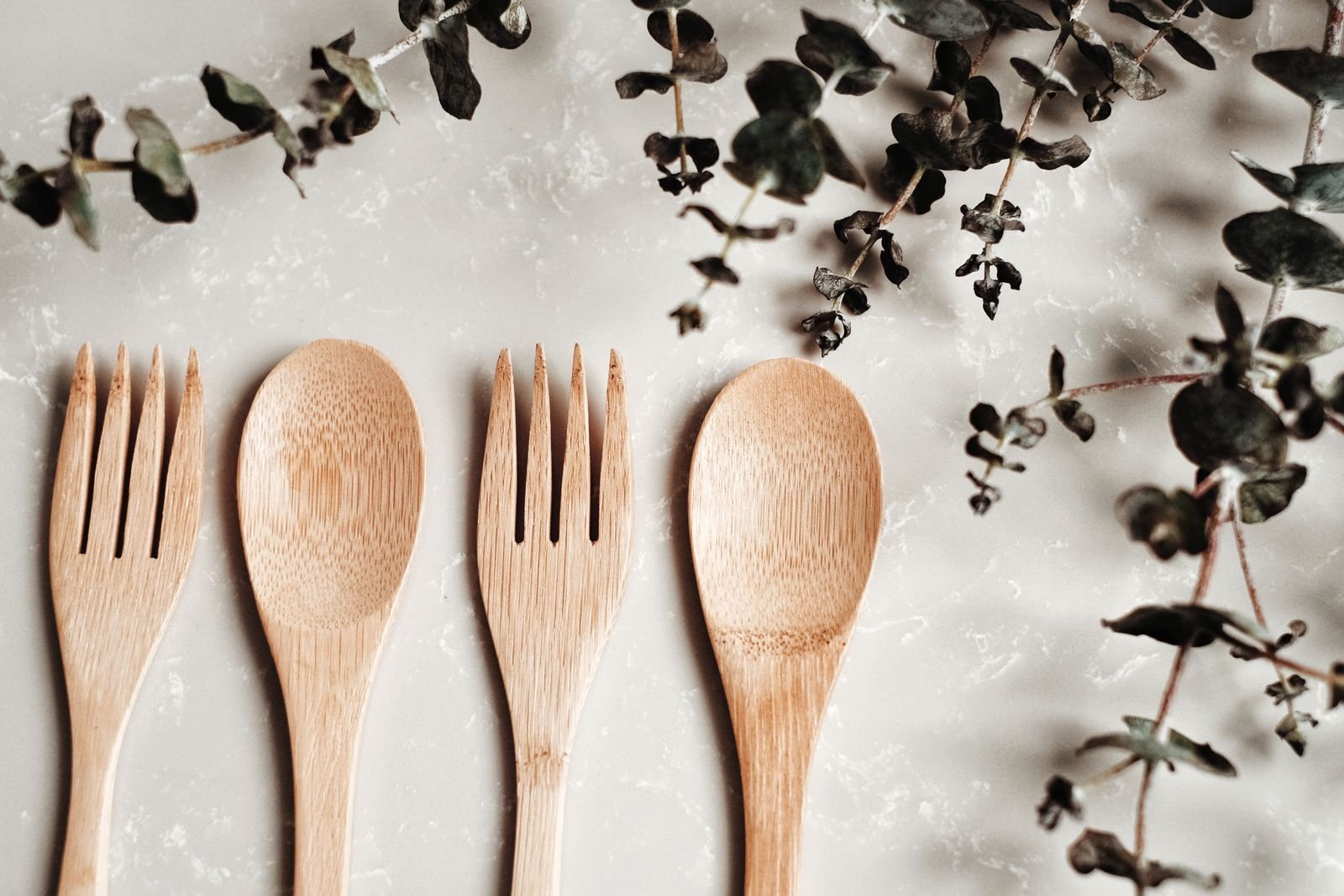
Cutlery is the item your customers judge with their hands, mid-meal, and it is where compostable ranges most often disappoint. A fork that flexes under a firm salad or a knife that folds against a chicken breast undoes the goodwill created by good containers. Compostable cutlery wholesale buying is therefore less about finding a material with the right label and more about matching a material’s real limits — heat, stiffness, composting route — to the food you serve. This guide works through the four material families you will meet in the market, the tests that expose weak cutlery before you commit, and the wrapped-set format that delivery has made the default.
One disclosure up front, because it shapes everything below. At Daoxiang we mould sugarcane bagasse tableware in our own factory in Hebei, China — 126 products across six collections of plates, bowls, trays and containers. Our cutlery offer is deliberately narrower than our moulded range: we supply paper cutlery and individually wrapped cutlery sets, not CPLA, cornstarch or wooden cutlery. The sections on those materials describe what you will encounter across the market and how to judge it; the sections on paper cutlery and wrapped sets describe what we actually sell.
Compostable Cutlery Wholesale Materials: Four Families, Four Sets of Limits
“Compostable cutlery” is a shelf label, not a material. The four families behind it behave differently in hot food, in the hand, and at end of life, and they fail in different ways. The table summarises the working differences; the notes after it cover the points buyers most often get wrong.
| Material family | How it is made | Heat behaviour | Stiffness in use | Composting route | Main cost drivers |
|---|---|---|---|---|---|
| CPLA | Crystallised PLA bioplastic, injection moulded | The most heat-tolerant of the group; the standard choice for hot meals | Rigid, closest to conventional plastic in feel | Industrial composting only | Resin price, crystallisation step, heavier gauges |
| Cornstarch-based | Starch blended with other polymers, injection moulded | Softens sooner than CPLA in sustained heat | Adequate for light food; heavier pieces flex under load | Depends on the blend — certification is per product, not per material name | Blend ratio, piece weight, certification scope |
| Wood / bamboo | Cut and pressed from birch, bamboo or similar timber | Handles heat well; can dry out and crack at extremes | Stiff but can splinter at thin sections if poorly finished | Widely accepted as compostable; check local rules | Timber grade, finishing quality, higher freight volume per piece |
| Paper | Layered, pressed and coated food-grade paper | Holds its stiffness through a normal meal; softens in prolonged liquid contact | Lightest feel; good grades cut soft food cleanly, weakest for heavy cutting | Recyclable or compostable depending on coating — confirm per product | Layer count, coating type, forming precision |
Three clarifications matter more than the table itself. First, “cornstarch” is a feedstock description, not a performance promise: blends vary widely, and two cornstarch forks at different prices are usually different products, not the same product at different margins. Second, composting route is a property of the finished, certified product, not of the raw material — a certificate such as EN 13432 covers a specific item at a specific thickness, so ask which exact SKUs a supplier’s documents cover.
Third, none of these materials should be described to your own customers as home-compostable unless the specific product carries that certification; most compostable cutlery is certified for industrial facilities, and claiming more than the documents say is a compliance risk in the EU and increasingly in the US.
For buyers comparing compostable cutlery wholesale quotations across families, normalise on piece weight and performance in your food, not on the material story. A cheaper, lighter piece that fails in service costs more than a heavier piece that does not — in complaints, in reorders lost, and in staff workarounds.
Heat and Stiffness in Compostable Cutlery Wholesale: Where Each Material Struggles
Heat failures in compostable cutlery wholesale samples rarely look dramatic. CPLA holds its shape in hot food but can turn brittle with age or poor storage, snapping rather than bending. Cornstarch blends lose stiffness gradually — the fork still looks fine while it slowly stops lifting food properly. Wood stays rigid but a dry, thin-edged knife can splinter at the tip, which is a finishing-quality issue rather than a material flaw. Paper cutlery’s limit is time in liquid: a paper spoon stirring tea or sitting in soup softens at the edges well before a moulded piece would, while the same spoon is perfectly serviceable across a normal plated meal.
Stiffness has a second dimension buyers forget: temperature of the food is only half the load. Cutting is the real test. Spreading, scooping and stirring are low-force jobs almost any compostable piece handles; cutting roasted meat or a firm baked potato separates the families quickly. If your menu is mostly salads, pasta, rice dishes and desserts, the stiffness gap between families narrows a lot, and lighter, cheaper pieces become rational. If your menu centres on grilled meats, be honest in your specification and test accordingly — no material story substitutes for cutting your actual food with the sample.
Strength Tests for Compostable Cutlery Wholesale Samples
Cutlery samples are cheap and failures are expensive, so test like a sceptic. Three simple checks, run with your own food, expose most of what a specification sheet hides.
The snap test. Take ten forks from the sample pack — not one — and flex each tine and handle firmly, then try to break a fork by hand at working force. You are not looking for unbreakable; you are looking for consistency. Nine sound pieces and one that snaps at the neck means a quality-control spread that your customers will also find. Record how the failures break: clean snaps at moulding points tell a different story from general brittleness.
The hot-food test. Serve your hottest, heaviest dish exactly as a customer receives it, and use the cutlery for the full meal, including cutting. Then leave a set in the hot food for fifteen minutes and use it again. Heat softening and stiffness loss show up in that second use, which is the one that matches a delivered meal eaten slowly.
The soak-and-stir test. For spoons especially: stir a hot drink repeatedly and rest the spoon in liquid for ten minutes. Note edge softening and any coating taste. Paper spoons will show their limits here first — which is useful information, not a disqualification, if your use case is a spoon that stirs once and is discarded.
Run the same three tests on every supplier’s samples, with the same dishes, and the quotations become comparable. A supplier who welcomes specific testing is also telling you something about how they expect their product to perform.
Turn the results into a written specification before you request final quotations: the material family, the piece weight or gauge you tested, the set composition and wrap format if you are buying sets, the hottest food the pieces must survive, and the exact SKUs you need certification documents for. Quotations against a written spec are comparable; quotations against a material name are not.

Why Individually Wrapped Sets Became the Delivery Default
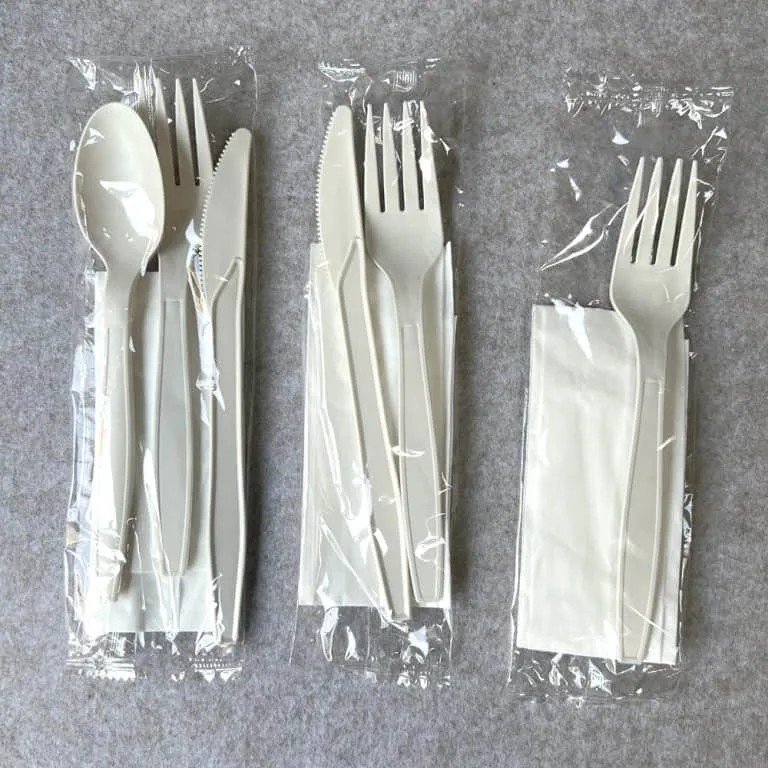
Loose cutlery in a bulk carton works at a counter, where staff hand pieces across or customers help themselves. Delivery changed the unit of issue. A meal leaving the kitchen now needs a complete, hygienic, countable kit that can be dropped into the bag in one motion — and that is what an individually wrapped set is: typically a knife, fork, spoon and napkin sealed together, with salt, pepper or a toothpick added in some market formats.
Three practical reasons drove the change. Hygiene became visible: a sealed set signals to the end customer that nobody has handled their cutlery, which matters for platform ratings as much as for food safety. Portion control became automatic: one set per meal removes the handful-grab problem of open dispensers and makes cost per order predictable. And packing speed improved: a wrapped set is one pick instead of four, which counts at peak hour.
For wholesale buyers, the specification points are the set composition, the wrap material, and how the sets pack — loose in a master carton for kitchen use, or in retail-ready packs if you resell. If your operation still serves at a counter, loose pieces remain the cheaper format and there is no reason to pay for wrapping you do not need. If any meaningful share of your volume is delivery or takeaway, wrapped sets are usually the format your operation will standardise on.
Paper Cutlery and Wrapped Sets: What Daoxiang Supplies
Our own range is the paper row of that table, plus the wrapped sets from the previous section — and we would rather be precise about that than appear in searches we cannot serve. Daoxiang supplies paper knives, forks and spoons — pressed, layered paper with the stiffness limits described above, well suited to the lighter-duty menus covered in the heat section and to bakery service — and individually wrapped cutlery sets built for the delivery use case. What we do not supply is CPLA, cornstarch or wooden cutlery; if your menu needs CPLA’s heat performance, the honest advice is to source that line from a supplier who moulds it, and the tests above will help you judge their samples.
Where paper cutlery and wrapped sets earn their place in an order from us is consolidation. Cutlery is rarely a buyer’s only line: the same shipment usually carries the moulded bagasse containers, trays and bowls that the cutlery is served with — the takeaway range is covered in our compostable takeaway containers wholesale guide. Our stock-mould minimum is 5,000 pieces per SKU across the catalogue, and cutlery ordered alongside your main tableware lines rides in the same production and shipping cycle instead of a separate small-order process. You can see where the cutlery sets sit in the range on our full product catalogue.
Paper also has one honest advantage worth naming: it avoids the brittle-snap failure mode entirely. A paper fork that is overstressed bends; it does not shed fragments into food. For buyers supplying schools, airlines, events and other settings where a snapped tine is a serious incident, that failure behaviour is a genuine selection criterion, not a marketing line.
Frequently Asked Questions
What is the minimum order for compostable cutlery wholesale at Daoxiang?
Our minimum order is 5,000 pieces per SKU for stock items, and it applies the same way whether the SKU is a paper fork, a wrapped set or a moulded bagasse container. That makes it practical to build a first order around your highest-volume pieces and add slower lines once you have tested them in service.
Does Daoxiang sell CPLA or wooden cutlery?
No. Our cutlery range is paper cutlery and individually wrapped cutlery sets. We cover CPLA, cornstarch and wood in this guide because buyers comparing compostable cutlery wholesale options will meet all four materials, and the limits of each are what a sound buying decision turns on — but we only quote on what we manufacture and supply.
How long do samples and production take?
Samples are free and are sent within three days, so you can run the snap, hot-food and soak tests in this guide with your own menu before committing. Regular production runs on a 15–20 day cycle once an order is confirmed.
Are wrapped cutlery sets worth the extra cost over loose pieces?
For counter service, usually not — loose pieces are the economical format. For delivery and takeaway, the set replaces four separate picks with one, keeps the cutlery visibly hygienic, and fixes your cost at one set per meal. Most buyers who run both channels end up stocking loose pieces for the counter and wrapped sets for delivery.
Which certifications support sales in Europe and the US?
Daoxiang products are certified to FDA and LFGB food-contact requirements and to EN 13432 for compostability, and the factory operates under ISO 9001. Certification is product-specific, so ask for the current documents for the exact cutlery items you are buying — and if a supplier makes compostability or additive claims for a material, ask for the test report for that SKU rather than relying on the material name.
Can cutlery be combined with other products in one shipment?
Yes — that is how most of our cutlery orders run. Paper cutlery and wrapped sets are typically ordered with bagasse plates, bowls, trays and containers from the same 126-product catalogue, produced and packed in the same cycle. The ordering picture is explained in our MOQ, samples and lead times guide.